Dungeons & Dragons
Group storytelling with dice, snacks, and one friend who takes it far too seriously — in the best way.
- Cost to start
- ~$60 to start
- Learning curve
- 3 / 5
- Typical session
- 3–4 hours
- Physical demand
- 1 / 10
- Social level
- 9 / 10
- Setting
- At home
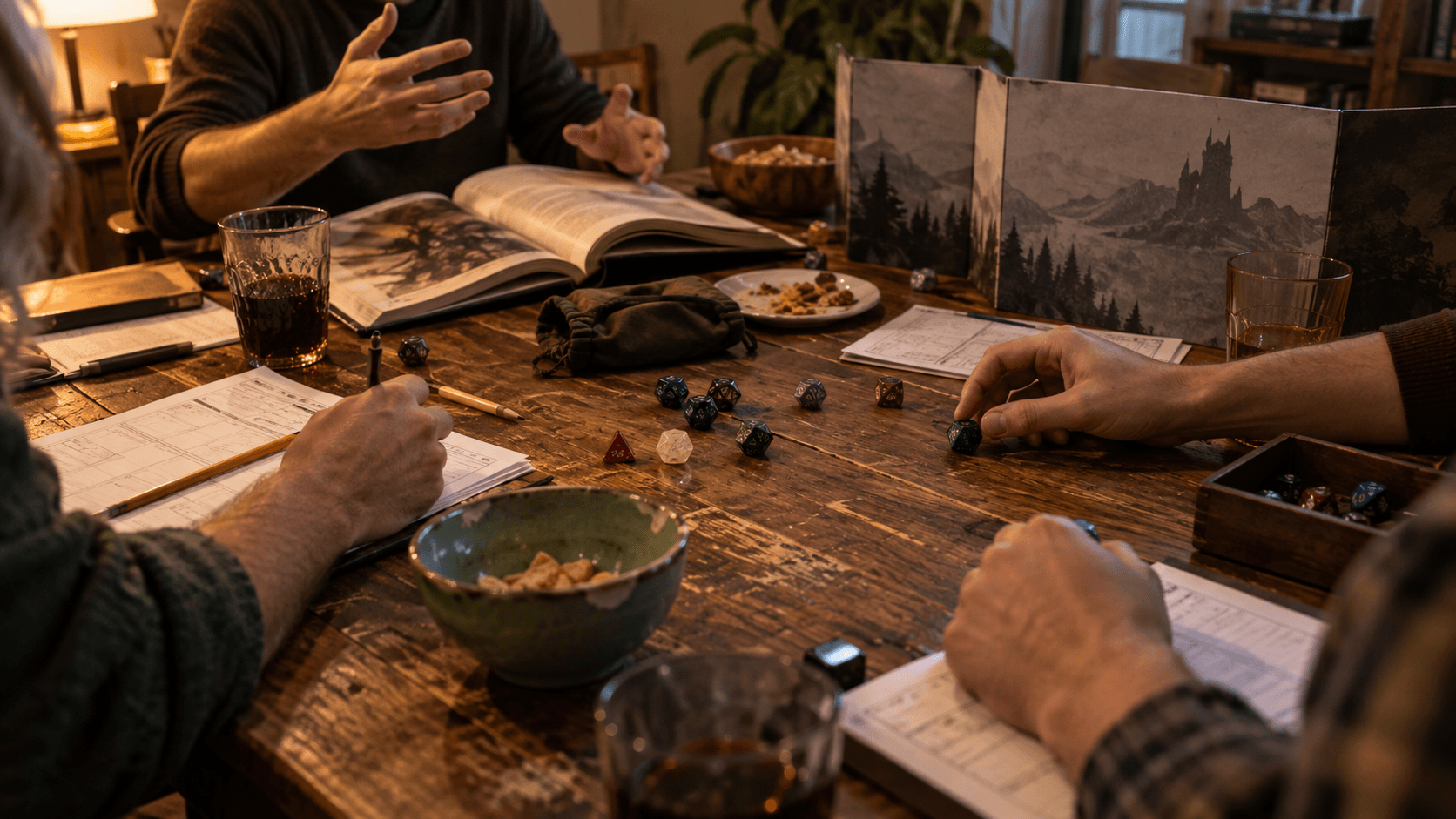
D&D is a structured excuse to sit around a table with friends and make things up for an evening. One person (the Dungeon Master) describes a world and plays everyone in it; the rest of you play one character each and decide what they do. Dice settle the arguments.
What it costs
Bare-minimum start: about $15 — the free Basic Rules PDF (covers character creation and the core rules for months) and one set of polyhedral dice (~$14) for whoever doesn't already have one. You don't need a printed book to try it.
Practical setup: about $60 for the table to share. A Player's Handbook ($30, one copy for the group) is the real upgrade over the free rules — clearer explanations, more options, something to flip through at the table. Add a Starter Set or Essentials Kit (~$15), which comes with a ready-to-run adventure so nobody has to build a world from scratch, plus a set of dice (~$14) for anyone without one.
Optional later: extra rulebooks (Monster Manual, Dungeon Master's Guide) once someone wants to run their own campaigns instead of the starter adventure, and miniatures or a battle mat — purely cosmetic, not required to play.
The only real ongoing cost is snacks and, eventually, a subscription to an online tool like a virtual tabletop if your group ever plays remotely — neither is required for an in-person game with a printed adventure.
What to buy
One Player's Handbook for the table to share — it's the group's reference, not a personal purchase each. A Starter Set or Essentials Kit if nobody has run a game before; it comes with a finished adventure, pre-made characters, and simplified rules, removing the single biggest barrier to a first session. A set of polyhedral dice for anyone who doesn't have one.
Skip buying a Dungeon Master's Guide or Monster Manual before your first session — the Starter Set's simplified rules cover everything you need, and those books are for once someone wants to build their own adventures. You can also borrow character sheets and reference cards for free online rather than buying accessories marketed for organizing them — a first group rarely needs more than the kit provides.
How to start
Start with the Starter Set's pre-written adventure and a group of four or five people who already like each other. You don't need to build your own world for game one.
Pick who wants to run it as Dungeon Master — usually whoever suggested playing — and have everyone else make a character using the kit's pre-made options rather than building from scratch, which can eat an entire evening on its own. Sessions run three to four hours, so schedule it like any other standing plan, because "we'll figure out a time" is how most new groups quietly stop playing.
For the first month, stick to the starter adventure rather than switching to homebrew — most new Dungeon Masters overestimate how much prep an improvised session needs and burn out trying to build a world before the group has even learned the rules. Progress looks like the table needing the rulebook less each session, not a more complicated story. There's no real physical risk here, but there is a social one worth naming: agree as a group upfront on what topics are off-limits in the story, so nobody is blindsided mid-session — most groups never need this conversation, but the ones that skip it and hit a problem tend to quietly stop playing instead of just saying so.
Is it for you?
D&D suits people who like collaborative storytelling more than winning, and who can commit to a recurring three-to-four-hour block with the same group — it's a scheduling hobby as much as a game. If your group can't find a consistent slot, or someone in it hates being put on the spot to improvise, it's genuinely harder to sustain than the rulebook lets on. If you've got the group, it's one of the cheapest hobbies here per hour of fun.
Starter gear
Soft suggestions to get going. These are affiliate links — buying through one may earn us a commission at no extra cost to you.