Coin Collecting
Finding out whether the weird quarter in your junk drawer is treasure or just a quarter.
- Cost to start
- ~$45 to start
- Learning curve
- 2 / 5
- Typical session
- 20–40 min
- Physical demand
- 1 / 10
- Social level
- 1 / 10
- Setting
- At home
Coin collecting has a reputation as a retiree's hobby, all velvet trays and magnifying glasses. Most of it, honestly, is just checking whether the weird coin in your car's cupholder is worth anything — and it usually isn't, which is itself useful information, cheaply gained.
What it costs
Bare-minimum start: $0. Sort through the coins already in your wallet, car, and couch cushions, and use a free coin-ID app or website to find out what you actually have. Most pocket change turns out to be exactly what it looks like, and confirming that costs nothing.
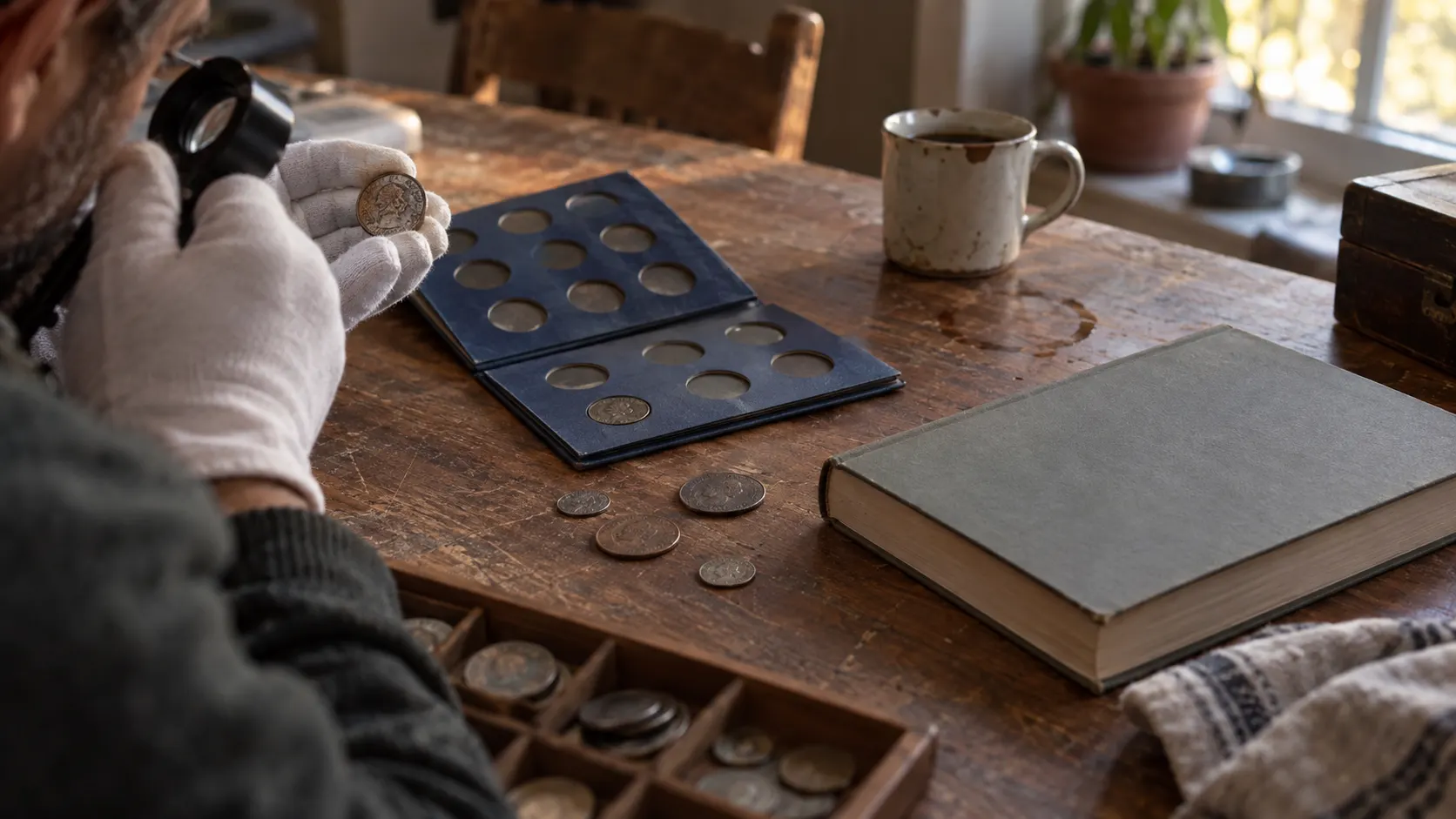
Practical setup: about $45. That is a jeweler's loupe (~$10) for reading dates and mint marks that are often too small to judge by eye, a beginner coin folder for one specific series — Lincoln cents or state quarters are the standard starting points (~$12) — a pair of soft cotton handling gloves (~$8), since skin oils slowly damage coin surfaces, and a current price guide like the Red Book (~$15) to separate real value from wishful thinking.
Optional later: a digital coin scale, a UV light for spotting alterations, and eventually a small safe once a collection has genuine value — none of this matters until you are well past the beginner stage.
There's essentially no ongoing cost beyond the occasional new folder page or an updated price guide every couple of years, since prices do shift. This is one of the cheaper hobbies here to maintain once the starter kit is bought.
What to buy
A 10x jeweler's loupe, since mint marks and wear details are often invisible to the naked eye. A folder or album built around one specific coin series rather than a "collect everything" approach — focus is what actually makes a beginner collection coherent and eventually complete. Cotton gloves, to stop the fingerprint etching that quietly ruins a coin's value over years. A current price guide, because a coin's condition matters more to its value than its rarity, and guessing at condition is the single most common beginner mistake.
Skip coin cleaning products entirely. Cleaning a coin, even gently, is one of the fastest ways to destroy its collector value, and it is not reversible. You can also borrow rather than buy a price guide at first — most public libraries carry a current Red Book, which is plenty for checking a handful of finds before you decide to own one yourself.
How to start
Start by sorting through your own pocket change and car cupholder with a coin-ID app open next to you. You do not need a loupe or a price guide yet for this part.
Once you have found a few coins that look genuinely old, worn unusually, or do not match a normal date-and-mint pattern, that is when the loupe and guide start earning their cost. Pick one series to build a folder around rather than collecting broadly — a complete set of something specific is both more satisfying and more valuable than a scattered pile. Check a few new coins a week rather than binge-sorting once a month; collecting rewards steady small checking far more than long occasional sessions.
The most common beginner mistake, beyond cleaning coins, is assuming old automatically means valuable — condition and how many were originally minted matter far more than age alone. A closely related mistake is handling coins by their faces instead of their edges, which is exactly the kind of small habit a price guide or an experienced collector will correct within your first few sessions.
Is it for you?
Coin collecting suits people who like small, methodical research projects and do not need a fast payoff — most finds are ordinary, and that is expected, not a failure. It rewards patience and record-keeping more than luck. If you want dramatic, frequent "big find" moments, you will be disappointed; if you like quietly getting better at noticing detail, it is a cheap and genuinely educational habit to keep.
Starter gear
Soft suggestions to get going. These are affiliate links — buying through one may earn us a commission at no extra cost to you.